
The Hidden Cost of AI And Why We’re All Paying for It
.png)
Contents
In the previous editions of this series, we journeyed from the moat NVIDIA has built around its business through CUDA, to the different facets of AI infrastructure, to now where we see that AI is becoming an infrastructural problem. Not just a software problem, or a chip problem, but an electricity problem.
Global data center electricity demand is projected to double to 945 TWh by 2030, roughly equivalent to Japan's entire annual grid consumption. In 2025 alone, electricity demand from data centres grew by 17%, with AI-specific workloads growing even faster.
But infrastructure does not just enable AI. It draws from the physical world, which raises a question deeper than just "Can we power AI?", which is, "At what cost, and to whom?". In this newsletter, I share my thoughts on the technological quagmire we seem to be heading towards.
Water: The Invisible Constraint
We tend to think of AI as something intangible – models, code, cloud. Something which lives in the ether and scales without friction. Needless to say, it does not.
Every AI system runs on electricity, water, land, and physical infrastructure. And as AI scales, that footprint expands in ways which are only beginning to show up at places where people actually live. Data centres are expected to account for around 50% of electricity demand growth in the US this decade. But electricity as it turns out, is only the beginning. The reason water does not garner as much attention, is because it is not an issue which has risen to significant levels of public concern just yet. And that is a problem, since modern AI infrastructure is as much a water system as it is an energy system.
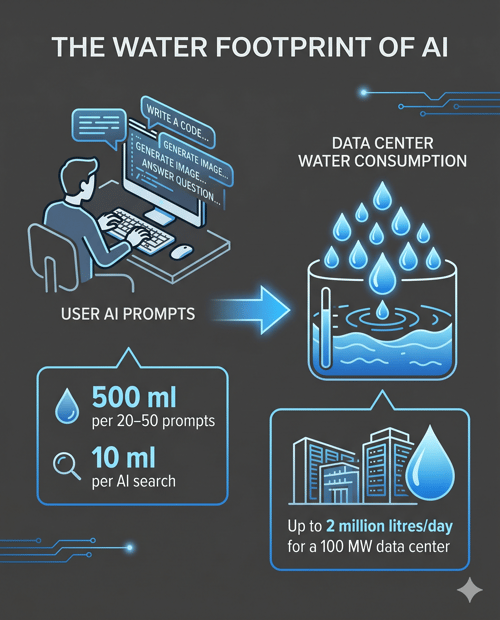
A single session of 20 to 50 prompts on a frontier AI model consumes roughly 500 ml of water for cooling, and even a simple AI-enhanced search query evaporates around 10 ml. Multiply that by billions of daily interactions and the numbers become difficult to look at calmly. A single 100 MW facility can consume 2 million litres per day. A 1 GW campus (a scale now being discussed as routine) draws up to 757 million litres annually, eight times what a traditional facility uses.
To top it all, it is the location of these facilities which makes the situation sharper. Two-thirds of data centres built since 2022 are located in water-stressed regions. In Bengaluru, data centres consume 26 million litres annually even as the city faces what researchers are calling its worst water crisis in five centuries. Following the UN's January 2026 declaration of Global Water Bankruptcy, the zero-sum nature of these choices is no longer theoretical, but a visible, local, and already producing conflict.
Let us remind ourselves that money can build a power plant but it cannot manufacture new water sources.
E-Waste: The 3-Year Cycle
See, traditional infrastructure is generally designed to last 50 years. However, AI hardware has shattered that model entirely. The pressure to keep pace with model growth has driven the industry to a 24-to-36-month hardware turnover cycle. GPU clusters which were state-of-the-art in 2023 are already being decommissioned and replaced. This aggressive cycle is a primary driver of the global e-waste market, which is projected to reach US $63 Billion by the end of 2026.
But the deeper problem is architectural. We are building what we call permanent intelligence on the back of hardware which is retired before the concrete of the facility housing it has fully cured. The intelligence endures, the machines producing it are disposable, and the cost of disposing of them is not borne by the companies which benefit from them.
Land and Community: The Social Debt
AI infrastructure also takes up space. A lot of it. The emergence of what the industry now calls the 1 GW Club (campuses concentrating the power demand of entire cities into a single facility) is triggering a wave of community resistance the sector did not anticipate. In Virginia's Data Center Alley, local opposition over noise and industrial impact led to the cancellation of 25 projects in 2025 alone. Homeowners discovered that these facilities are not quiet digital offices. They are noisy, resource-heavy industrial neighbours, and they arrived without much of a conversation.
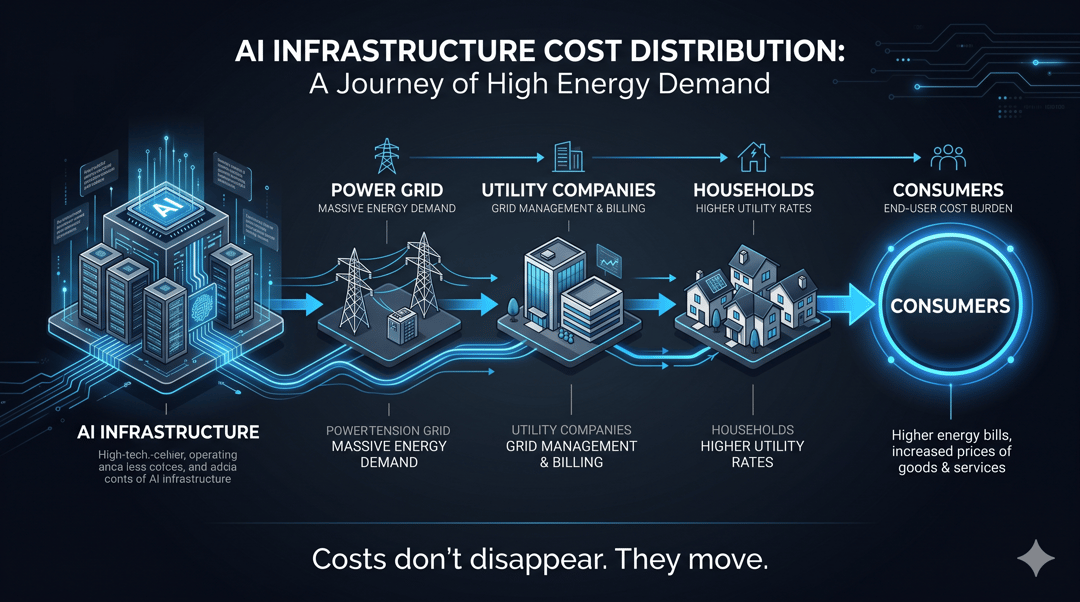
Compounding the social dimension is the financial one. The public is subsidising this expansion through electricity bills, albeit not through their choice. In the PJM market, capacity prices surged from US $28 to US $329 per megawatt-day, adding US $9.3 Billion in costs to ratepayers. Families in Maryland and Ohio are seeing monthly bill increases of US $16 to US $18 specifically to fund grid expansion for data center demand.
Once again, the cost of AI infrastructure is not contained within the companies which profit from it but is distributed quietly, through utility bills, into households which have no idea they are paying for it.
From Engineering to Allocation
Taken together, these pressures reveal something which most infrastructure conversations prefer to avoid. These are no longer engineering problems, but are in fact, allocation decisions. Who gets access to electricity? Who uses water, and where? Who bears the cost of infrastructure expansion? Who benefits, and who does not?
At this scale, AI infrastructure is a societal system and not just a technical one. And it is currently operating without the governance frameworks which societies normally apply to systems of such drastic consequence.
There is a real tension at the heart of this moment. On one side sits innovation, economic growth, and genuine technological progress. On the other sit resource constraints, community disruption, and an unequal distribution of costs and benefits that is becoming harder to defend. The question is not whether AI should scale. It will. The question is how it scales, and what we are willing to trade off in the process. An intelligence which bankrupted its neighbours' water supply and quietly raised their electricity bills would not qualify as advanced. It would qualify as extractive.
A Middle Path: Toward Regenerative Intelligence
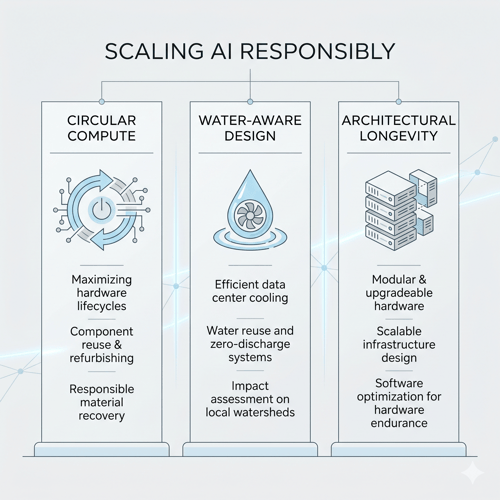
The answer to this conundrum is not to slow AI down, but to stop pretending that its costs are someone else's problem. Three directions point toward what this could look like in practice.
The first is circular compute. Hyperscalers must begin contributing to the utility systems they strain, not just drawing from them. Microsoft has already started supplying waste heat from its data centers in Denmark to warm 6,000 local households, and similar geothermal-compute hybrids are being piloted in France for urban heating. In March 2026, President Trump took this a step further, securing the Ratepayer Protection Pledge from Amazon, Google, Meta, Microsoft, OpenAI, Oracle, and xAI, committing these companies to build, bring, or buy their own power and cover the cost of all grid upgrades their data centers require, so those costs are not passed to American households. The pledge is voluntary and its enforcement mechanisms remain undefined, but it is a signal that the political cost of inaction has become real.
The second is water-aware design. Water must be treated as a primary design constraint, not an afterthought managed through corporate sustainability reports. This means making siting decisions which account for regional water stress, scheduling heavy training workloads away from drought periods, and treating water replenishment as an operational obligation. Google has pledged to replenish 120% of its water use. For 1 GW projects, this kind of commitment should not be voluntary.
The third is architectural longevity. The 24-to-36-month hardware replacement cycle is not a law of physics. It is an industry habit driven by the pressure to deploy the latest models on the latest chips. Modular server architecture (chassis designed to last 15 years, with only the compute components swapped every three years) could drastically reduce e-waste without sacrificing performance. The technology exists, but the incentive structure to adopt it does not yet.
Final Insight
As AI continues to scale, we must decide whether the systems which power it will be designed or merely assumed. Whether the communities which host it will be partners or casualties. Whether the companies which profit from it will internalise its true costs or continue to distribute them silently through utility bills and depleted aquifers.
This is a particularly prominent question for growing economies such as India, which is simultaneously attracting over US $65 Billion in data center investment from Google, Microsoft, and Amazon, watching OpenAI and Anthropic open offices on its shores, and confronting the very water and grid pressures which that scale of infrastructure brings with it.
There is a middle path between unchecked expansion and restrictive caution. It runs through honest accounting, genuine infrastructure reciprocity, and the recognition that the most important metric of 2026 is not FLOPs per second, but the sustainability of the ground beneath the servers.
The question is no longer only how we build AI. It is how we power it, sustain it, and justify its cost to the people who live near it.
As my personal motto goes – Planet, People, and Profits.