
Regulating AI: Two Years Later, Are Our Ambitions Still Safe?
Contents
Two years ago, I wrote about the need to regulate AI while safeguarding innovation. At the time, AI sat on the periphery of most critical systems. Today, that distance is gone. It is no longer a layer on top of the work we do. It is part of the foundation. The question is no longer whether we should regulate it. The real question is whether our institutions and behaviors have kept pace with what AI has already become.
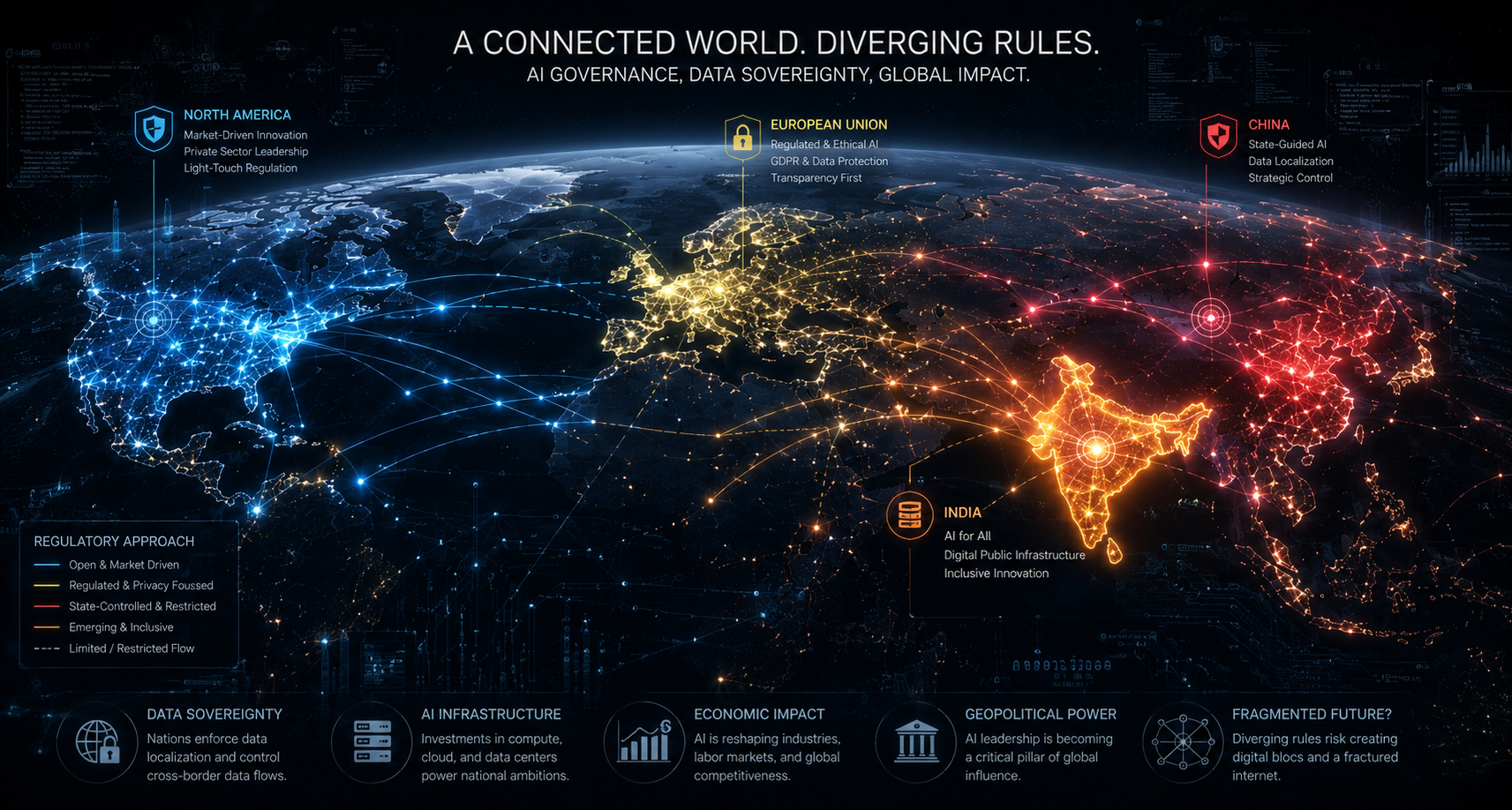
Back then, the expectation was convergence. A few major regions would set the tone, the rest of the world would then follow. This has not happened, and instead of convergence, we are seeing divergence. This fragmentation reflects a deeper truth: AI is not just a technological shift, but a geopolitical and economic one. Countries are positioning themselves through AI, and are not just regulating it.
In May 2024, the European Union had just reached a preliminary agreement on AI legislation, and most of the world was watching to see whether it would hold. It did. The EU AI Act entered into force in August 2024, with the first prohibitions on "unacceptable risk" AI practices applying from February 2025, and rules for general-purpose AI models from August 2025. The EU delivered what it promised: the world's first comprehensive AI law. And yet, the challenges of implementation have been humbling. The European Commission's November 2025 "Digital Omnibus" proposals sought to ease compliance obligations and defer key deadlines, a quiet admission that ambition and implementation are two very different things.
The United States, in 2024, was still in the "we should probably do something" phase. Two years later, it is a story of contradictions. The White House has lurched between pushing AI deregulation and asserting national control. Community opposition led to $98 Billion worth of data center projects being blocked or delayed between March and June 2025 alone. Democratic Senator Bernie Sanders and Republican Governor Ron DeSantis, two figures who agree on virtually nothing, have both emerged as leading critics of the AI data center boom. The public conversation about AI is no longer just about algorithms and bias, but about electricity bills and backyard infrastructure. All 50 US states introduced AI-related legislation in the 2025 session, and 38 states enacted around 100 measures, creating a patchwork the federal government is struggling to contain. The America which once set the global template for tech policy is now arguing with itself about who gets to set the rules.
Then there is Canada, perhaps the most instructive story of all. It was the first country to implement a national AI strategy in 2017, a founding member of the Global Partnership on AI, and helped write the grammar of responsible AI governance before most countries had started the conversation. Yet its flagship legislation died on the order paper in 2025, a casualty of political collapse and poor legislative packaging. Canada is still operating under a privacy law written in 2000, with no federal AI framework in place, and provinces are now filling a vacuum Ottawa left behind. Being an early mover is no guarantee of being a rule-setter.
This brings me to India, the part of the picture I now see up close. Rather than a new standalone law, India has opted for a light-touch model. IT Secretary S. Krishnan explained at the November 2025 launch of the AI Governance Guidelines: "India has consciously chosen not to lead with regulation but to encourage innovation while studying global approaches." It is a pragmatic start. But India is one of the world's largest reservoirs of data, attracting billions in foreign capital. Microsoft alone announced a $17.5 Billion investment in December 2025. Without robust data governance frameworks, India risks having its most valuable resource extracted quietly while the policy conversation stays focused on innovation targets. Financing a foreign, vertically integrated AI stack while neglecting domestic alternatives is not a strategy for sovereignty. It is a strategy for dependency, something India is historically wary of.
The question of who gets protected runs through all of this. In my 2024 article, I flagged algorithmic bias as a warning sign. It has since moved from a warning to courtrooms. In May 2025, a US federal court certified a nationwide class action against Workday, alleging its AI-powered hiring tools discriminated against applicants based on race, age, and disability. And yet, the Trump administration simultaneously ended the EEOC's AI and Algorithmic Fairness Initiative, directing agencies to deprioritize disparate-impact enforcement. The government and the judiciary are pulling in opposite directions. Meanwhile, Italy fined OpenAI €15 Million for GDPR violations and the FTC's Operation AI Comply began targeting deceptive AI marketing. Enforcement is arriving regardless of political appetite for it.
What has genuinely shifted is the global recognition that this cannot be solved country by country. The Council of Europe's Framework Convention on AI became the first legally binding international treaty on AI and human rights. South Korea enacted a comprehensive AI Framework Act in January 2026. Japan passed its AI Promotion Act in May 2025. The conversation is no longer a US-EU duopoly.
Beyond geography, the challenge has deepened. Enterprises are being forced to operationalize responsible AI, not just aspire to it. A small number of companies now control significant parts of the AI stack, creating a paradox where AI enables unprecedented creativity while centralizing control. And work itself is changing. In 2024, AI was helping people do their jobs better. In 2026, it is changing what those jobs are. The productivity gains are real, but uneven, and demand continuous adaptation.
Regulation alone cannot solve this. What we need are adaptable/agile policies, responsible organizational practices, and individual awareness working together. The challenge ahead is not just writing good rules. It is ensuring those rules protect people, not just processes, and that the benefits of this technology do not flow only to those with the resources, the infrastructure, and the leverage to shape it.
That is the work of the next two years.